Click on Your Ward to Locate & Write Your Elected Official
Hoboken is at a critical juncture right now. Major policies with long-term impact on our investments are being determined now.
Mile Square Taxpayers Association is Hoboken's nonprofit alliance of concerned property owners, who have come together to address regulatory and economic challenges that directly affect the value of their real estate assets.
Whether you own a condo, house or a portfolio of real estate, Miles Square Taxpayers Association represents the interests of all taxpayers in Hoboken.
We're building a better future for Hoboken taxpayers. Like you, we want lower taxes, city improvements that enhance our properties, and regulations that allow us to maintain and improve our facilities and receive fair compensation on our investments.
Please wait while my tweets load
MSTA is made up of Hoboken property owners who want to be involved in the laws, regulations and efforts that will determine Hoboken's future - now while they are being formed -- and not later when it's too late! MSTA provides a forum for information, counsel, and representation at Planning, Zoning, Rent Leveling, and City Council meetings in connection with issues that impact property owners. By acting as a unified presence, MSTA offers a resource to anticipate and avoid potentially negative legislation and regulations while promoting positive public policy.
To assure that the City of Hoboken considers the interests of property owners as laws and administrative policies are developed, initiated or revised.
Please seek advice from your accountant in tax deductibility of the contributions.
We thank you for your support and look forward to working with you to ensure the progress of our community.
This article calls for a reform of rent control in Hoboken that will not deprive tenants of their current rights; it simply will address the incompetent administration of the ordinance that has the potential for creating a new criminal class in Hoboken. Law Abiding, Tax Paying, Property Owners.
It also argues that Hoboken Property Taxes, especially on owner-occupied condominiums and single-family homes, will skyrocket if a solution is not immediately enacted.
The economic calamity caused by the current administration of the rent control ordinance has been documented elsewhere and to save time and space, we ask the reader to accept what the Courts, Administration, Council, Rent Leveling Office and the Department of Community Affairs have. We have a whitepaper on the topic posted at hobokenmsta.com.
Of course, Hoboken’s current situation is sufficient proof that its property tax policies were an unsustainable model, but like a virus that jumps from species to species, proliferating as it spreads recent litigation shows the damage the rent control ordinance is doing to Hoboken is not confined to people who own apartment buildings – but is affecting every property owner in town, including condominium and single family home owners.
The fiscal implications are simply arrived at: property ownership is discouraged when there is an uncertain rent leveling mechanism. When property is worth less its value declines. In Hoboken, multi-family properties make up nearly 20% of the tax base, not including smaller properties that are covered by rent control. Property owners are rightly appealing their taxes to reflect the devaluation caused by the arbitrary application of the ordinance. These appeals will be heard under a state formula and will succeed, reducing the property tax burden of apartment owners, which will be passed along to single-family homeowners. Owners of commercial property pay tax based on income and are immune to these dynamics. Most apartment owners claim that their property has been devalued by 40%, meaning that at least $240 million of current property tax ratables will need to be replaced.
But the interesting thing about this crisis is that condominium owners, especially those whose units were converted from rentals, are essentially downstream from the toxic event currently confronting real estate owners and investors and the condo owners who will suffer the most. Not only have their taxes increased to support a fiscal; budget that grew by 47, they are subject to the same threat from the misadministration of the rent control ordinance as multi-unit property owners because unlike almost every other rent control community in New Jersey, Hoboken provides rent control protection to tenants renting single-owned condominium units. If a condo owner is renting out his unit, it is unlikely to have been registered . Although the swell rent he is getting from the current tenant covers his taxes and maybe more, it’s not legal. Based on the capricious administration of the ordinance, the rent could be calculated from a base rent charged in the 1980’s. In a recent case, the owner was forced to roll back the rent charged to reflect a 1981 base rental. Moreover, the condo owner was sued for treble the difference in rent for the entire term of the tenancy, even though he only collected rent for a short time.,
In such a case, where the expected finding will bankrupt the apartment owner, the property tax discussion is inconsequential. But even in cases where ownership remains viable after a rollback, a property tax appeal is significantly more complicated because a condo owner will not be afforded the same standing as professional apartment investors. Left without equity in condo units and insufficient cash flow to pay the property taxes - forget their mortgages - a prospective wave of condo short sales could occur that will bring down the values of all the other condos. If the condos are owner-occupied owners won’t escape the property tax burden that will be allocated to them as other property tax revenues evaporate.
Except a few of them. It will come as no surprise that politicians have been perfectly willing to forego tax collection in order to curry favor with any number of groups – not just tenants and not just using the rent control ordinance as a vehicle. Tax abatements to encourage new development limited or precluded tax increases for many newer residents. These are the most valuable units in Hoboken and they will not be asked to bear additional tax burdens until their abatements expire – most many years from now.
But don’t worry – after refusing to address this at its last meeting on an emergent basis, the Council convened a Committee to research the problem. Raise your hand if you are optimistic that a realistic solution will result from that gathering.
*City Administrators refused to release these figures without a FOIA Request and they had to be obtained my other means, which is one heck of a way to endear yourself to the public: withhold public information from them.
However, the absence of the political will by the Council and the administrative will by the Rent Control Office have lead to a situation where litigation is ruling the day.
Because of regulatory contradictions under different administrations, it is a practical impossibility for an owner to demonstrate that his rent is “legal,” which subjects him to litigation. The central vehicle to obtain the allowed 25% vacancy decontrol increase is a “vacancy decontrol form” whose filing was not mandatory for many years. Now that it is required, owners who previously failed to file are deemed not in compliance – and they are culpable for the actions of all prior owners. There is no statute of limitations and no limit on the term of the “look-back” for calculation, meaning that every calculation can go back to the implementation of rent control in 1981. Previous tenants are permitted to request calculations, but owners are not allowed to even view the file, forget cure the file, despite that their actions might have been correct.
Simply not filing a form, especially given that there was no regulatory impetus to do so, should not create a prospective windfall for the tenants (many settlements exceed $150,000+).
The Rent Control office is well aware of the situation and has expressed empathy, but is unable to change the law without Council action. The Council, on several occasions most recently in the fall of 2005, has acted to correct this issue. But reaction from tenant advocates has created a political dynamic that caused the law to be repealed. Hoboken at its best: there was never any sense of fairness or balance when dealing with this issue, it was just politics.
Predictably, the situation has created threats. Owners are being subjected to enormous exposure and property values are threatened because of clouds to their title. There is a liability time bomb in every building in the form of unscrupulous attorneys bringing suits that exploit the circumstances and apartment owners are sitting ducks. The dynamic is certain to create a legitimate and effective claim on property values, resulting in massive tax appeals that will further challenge the city’s fiscal conditions. And at least one lawsuit that challenges the administration of the law as arbitrary and capricious has made it through the summary dismissal stage and, if successful, could result in the entire rent control ordinance being set aside.
Property Tax Appeal Spiral. The fiscal implications are simply arrived at: property ownership is discouraged when there is an uncertain rent leveling mechanism. When property is worth less its value declines. In Hoboken, multi-family properties make up 20% of the tax base, but property owners rightly are appealing their taxes to reflect the devaluation caused by the misadministration of the ordinance. These appeals will be heard under a state formula and will succeed, reducing the property tax burden of apartment owners, which will be passed along to single-family homeowners. Owners of commercial property pay tax based on income and are immune to these dynamics. Most apartment owners claim that their property has been devalued by 40%, meaning that millions of current property tax receipts will need to be replaced.
Market Consequences for Condo Owners Condominium owners, especially those whose units were converted from rentals, are essentially downstream from the toxic event confronting professional real estate investors and will suffer the most. Not only have their taxes increased by 47%, they are subject to the same impact from misadministration of the rent control ordinance as larger property investors because unlike almost every other rent control community in New Jersey, Hoboken provides rent control protection to singly-owned condominium units. If a condo owner is renting his unit, he is unlikely to have registered it, and despite that the swell rent he is getting from the current tenant covers his taxes and maybe more, it’s not legal. Based on based on the misadministration of the ordinance, the rent of the last legal registration will likely be ruled to be in the 1980s. In an ongoing case, a current rent was rolled back to that, and the condo owner was sued for treble the difference in rent for the entire term of the tenancy, despite that he only collected rent for a short time, under the New Jersey Consumer Fraud Act.
In such a case, where the expected finding will bankrupt the apartment owner, the property tax discussion is inconsequential. But even in cases where ownership remains viable after a rollback, a property tax appeal is significantly complicated because a condo owner will not be afforded the same standing as professional apartment investors. Left without equity in condo units and insufficient cash flow to pay the property taxes, forget their mortgages, a prospective wave of condo short sales could occur – which will bring down the values of all the other condos. But if they are owner occupied they won’t escape the property tax burden that will be allocated to them as other property tax revenues evaporate.
No matter how you feel about rent control as a social practice, like any other process or regulation administered by the City, if it is not reasonably enforced it is of grave prospective harm. Gaps in administration of the Ordinance over a 25 year period have come home to unfairly punish our industry through no fault of its own.
In addition to the litigation against the City, current litigation brought by tenants features the following circumstances:
Immediate action must be taken to assure the viability of the most important asset in Hoboken: its rental housing stock. It is little wonder that apartment owners use condo conversion as a means of generating a return on their investment and avoiding the prospective implications of not being able to prove their rents are legal.
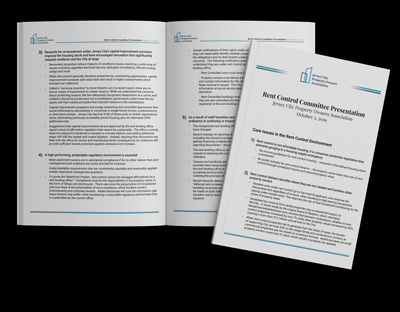
Hoboken’s rent leveling ordinance has been the subject of nearly 2 years of intense scrutiny and debate, leading to a 9-0 vote by the Council to adopt an amendment (Z-88) to correct administrative and legislative issues that led a judge to conclude the ordinance was “arbitrary, capricious and unconstitutional” and that the rent leveling office’s records are unreliable. Rescinding the Council’s action would return Hoboken to a chaotic rent control environment in which property owners would be subject to liabilities despite that they were complying with the ordinance as it was administered at the time, leading to continued litigation and a frozen market for rent control properties in Hoboken.
The Council researched the ordinance and held 9 hearings within an 18-month time period beginning in September of 2009. Z-88 is the result of that process, during which tenants’ and landlords’ arguments were considered and helped shape the amendments that were passed by the Council unanimously 9-0. Subsequently, the Council rejected a petitioner’s motion to rescind the amendment, leading to the question appearing on the ballot.
The amendment has five essential components:
Z-88 adds an important protection for tenants, for the first time requiring that they are notified of their right to request a legal rent calculation from the rent leveling board.
The central problem that caused the rent leveling ordinance to be deemed unconstitutional was the requirement of a vacancy decontrol form to be on file at the rent leveling office to qualify for increases in rent. This form was never produced by the rent leveling office – rent leveling board administrators testified in depositions for a Superior Court case that they had regularly instructed property owners to note decontrols on their registration statements. More recently, the rent leveling office changed this policy, producing a form and requiring it. The Court found that landlords could not be expected to file a form that was not accepted by the rent leveling office, and the Council subsequently adopted the Z-88 amendment to re-establish the constitutionality of the law. Elementally, allowing accused persons to provide evidence in their own defense is an inalienable right. In a circumstance where the rent leveling board’s records were deemed unreliable, accepting and assessing evidence provided by landlords, who are in possession of leases that demonstrate their compliance with rent increase standards, is the intent of this Z-88 component.
Z-88 provides a tenant with a 2-year period of repose to request a legal rent calculation and provides for a 2-year maximum refund of overpaid rent, which would be tripled under the Consumer Protection Act and result in 6-years of refund of overpaid rent. Rents would still be rolled-back as far as 1985 if found to be over-charged. This is the most generous return-of-rent and repose period in Hudson County.
Currently, most violations of the rent leveling ordinance result in cases in Superior Court. The Z-88 amendments provide some powers to the rent leveling board to adjudicate matters – but those powers do not exclude any party from appealing to Superior Court. In instances where the rent leveling board makes a ruling that is abided by both parties, significant legal expenses are saved by the city, the landlord and the tenant. More than $500,000 in rent control related legal fees have been borne by Hoboken in the last year.
This is the first year record keeping of rent registration was formalized and is the earliest, although still unreliable, opportunity to assess legal rents.
Tenant attorneys working on contingency fees in Hoboken exploit the administrative gaps in the law and rent leveling office to create “phantom violations” in which a property owner may be charging a legal rent but is still not in compliance with the technical language of the law. Under the Consumer Protection Act, it is impossible to overcome the flaws in the ordinance -- in fact, the current owner of the property is liable to return rents they did not even collect. Settlements and awards have routinely been in the hundreds of thousands of dollars, with lawyers soliciting entire buildings that are then driven into bankruptcy by the findings. And, once the rent is rolled back, the buildings are virtually valueless. This is not the intention of the rent control law, and more elementally, it is unethical to knowingly take property from one person and hand it to another with no legitimate exchange of value. The single impact from the Z-88 amendment is to prevent that abuse. Z-88 does not eliminate any tenant legitimate protection, it eliminates an attorney’s windfall.
Without Z-88, property owners are encouraged to convert rental properties to condominium to avoid liabilities. This is the most serious threat to maintaining affordable rental stock in Hoboken.
Poorly functioning rent control laws further burden single-family homeowners with higher taxes (because rent control restricts income to buildings, they pay less in tax than they otherwise might). By unnecessarily and unfairly rolling back rents, single-family homeowners must pick up the burden for town expenses. By incurring increased legal expenses, single-family homeowners must pick up the burden, because rent control properties only pay tax on an income basis and their taxes cannot be increased unless their revenues are increased. =
Ultimately, if Council action does not cure the problems in the Hoboken rent leveling ordinance, judges will continue to do so, perhaps naming landlords the prevailing party in a pending class action against the city which has financial implications in the hundreds of millions of dollars.
The biggest problem in Hoboken is that the rent leveling office is managed in arrears rather than affirmatively. If, at the point of registration, rents were assessed for compliance by the rent leveling office there would be no need for legal rent calculations. Poor procedures and poor record keeping have resulted in poor outcomes for tenants, landlords and the city. Without the administrative capacity to mange the city’s ordinance affirmatively – which is what almost all other municipalities do – the amendment is necessary in order to establish an authoritative and functional rent leveling office, which is clearly the intent of the Council and should be the goal of any successful municipality.
Maintaining Z-88 is essential for a normal functioning rent control environment in Hoboken, as it:
- restores constitutionality to the rent leveling ordinance;
- overcomes unreliable record keeping by providing ability to supply alternative evidence;
- protects tenants by providing them notice of their rights;
- eliminates “phantom violations” that place unfair liabilities on property owners;
- removes the title clouds from buildings, thawing the real estate market;
- motivates property owners to maintain rental property rather than convert to condominiums ensuring greater access to affordable rental stock in Hoboken;
- supports the public discourse, Council research, and the democratic process that took place over 18 months that resulted in a unanimous 9-0 vote to implement the amendment.
Phone: 201.605.1060
Email: info@hobokenmsta.com
Address: P.O. Box 344 Hoboken, NJ 07030